AI Persona Generator: How to Build Customer Personas From Real Data (2026)
An AI persona generator workflow that uses real customer data instead of fiction. Inputs, prompts, audit checks, and what most vendor tools miss.
Most AI persona generators output garbage.
The pattern is the same across vendor tools: you fill in some industry and a target role, click a button, and the AI produces a fictional person with a stock photo, a list of generic pain points, and motivations that could apply to literally any human in that industry. “Sarah, 34, marketing director, values efficiency and growth.” Useless.
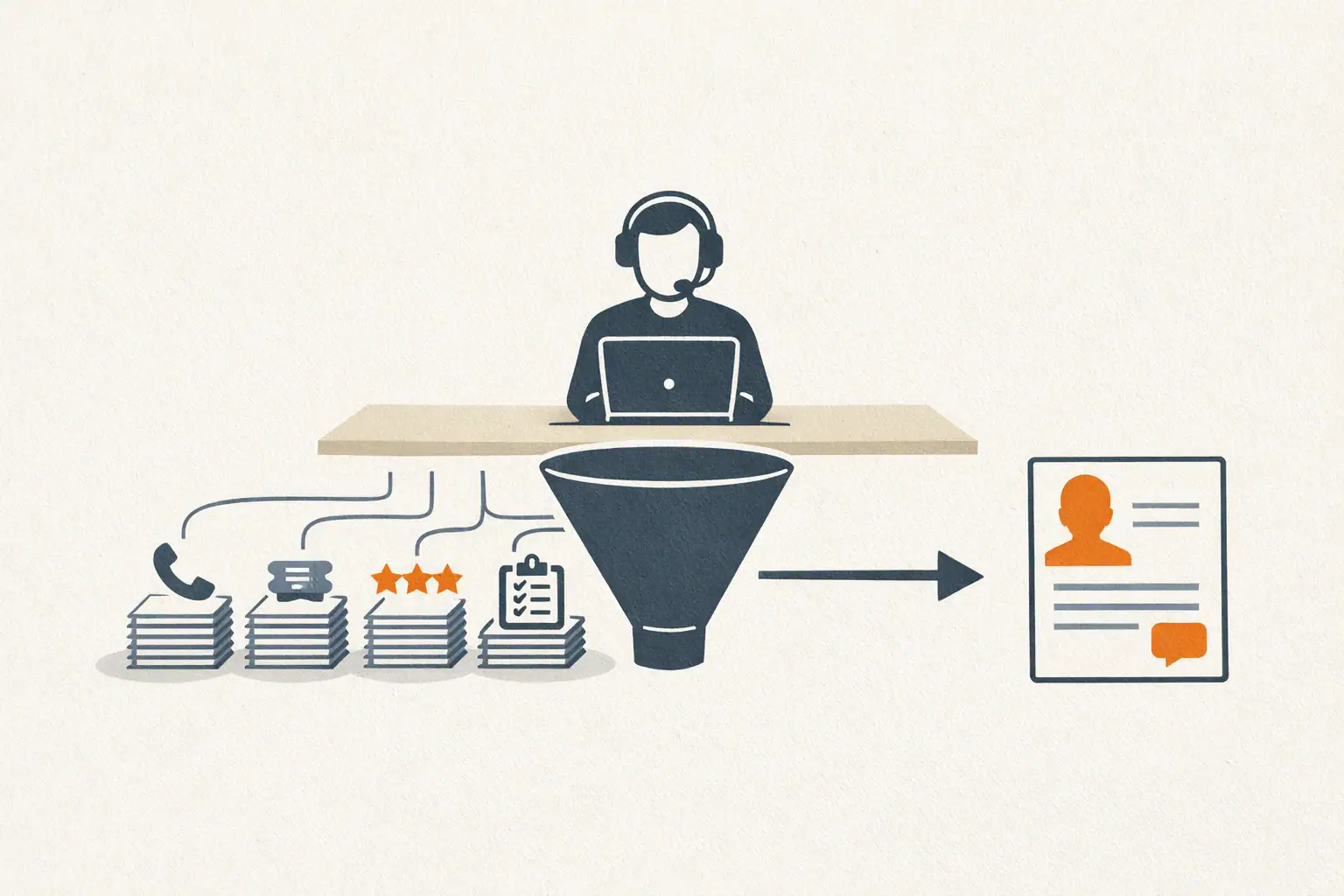
A working AI persona generator doesn’t start from a blank prompt. It starts from your actual customer data: support tickets, sales calls, reviews, surveys, churn interviews. The AI’s job is to synthesize patterns from real evidence, not invent fictional people from clichés.
This post is the workflow we use to build real personas with AI for ravitz.co clients. The prompts, the data inputs, the audit checks, and the exact reasons most persona-generator output isn’t usable.
For the broader research stack this sits inside, our 30 ChatGPT prompts for marketers post has the prompts we run for the underlying research synthesis.
The persona problem most teams have
Three patterns make most existing personas useless:
They’re fiction. Built from a brainstorm in a Notion doc or a vendor tool, never grounded in evidence from real customers.
They’re stale. Built once during a brand exercise three years ago and never updated, even though the actual customer base has shifted underneath them.
They’re decoration. Printed on a slide for a quarterly all-hands, then never used to make a decision about copy, ads, product, or pricing.
A persona that doesn’t get used is just a slide. The point of an AI persona generator workflow is to produce personas that drive specific decisions: which headline to write, which objection to handle on the landing page, which pricing tier to feature, which channel to test. Nielsen Norman Group’s research on personas is the canonical reference for why most persona programs fail and what makes the working ones different. The 2026 update on that thinking is that AI doesn’t fix any of the underlying problems. It just makes the evidence-grounded version faster to produce.
What “AI persona generator” should actually mean
The vendor-tool version of an AI persona generator: input some industry + role, click button, get fictional human. Output isn’t tied to anything real.
The operator version: input real customer data, run it through a synthesis prompt, get patterns grounded in evidence. Output is auditable. You can trace every claim about the persona back to the source data.
Both versions can be called “AI persona generator” but only the second one is useful for marketing decisions.
We covered why most AI marketing tools fall into the first category in our complete AI marketing stack post. The pattern is the same here: vendor tools that hide the workflow behind a button are often hiding that there’s no real workflow underneath.
The data inputs that actually matter
A persona is only as good as the data you feed the generator. The high-leverage inputs:
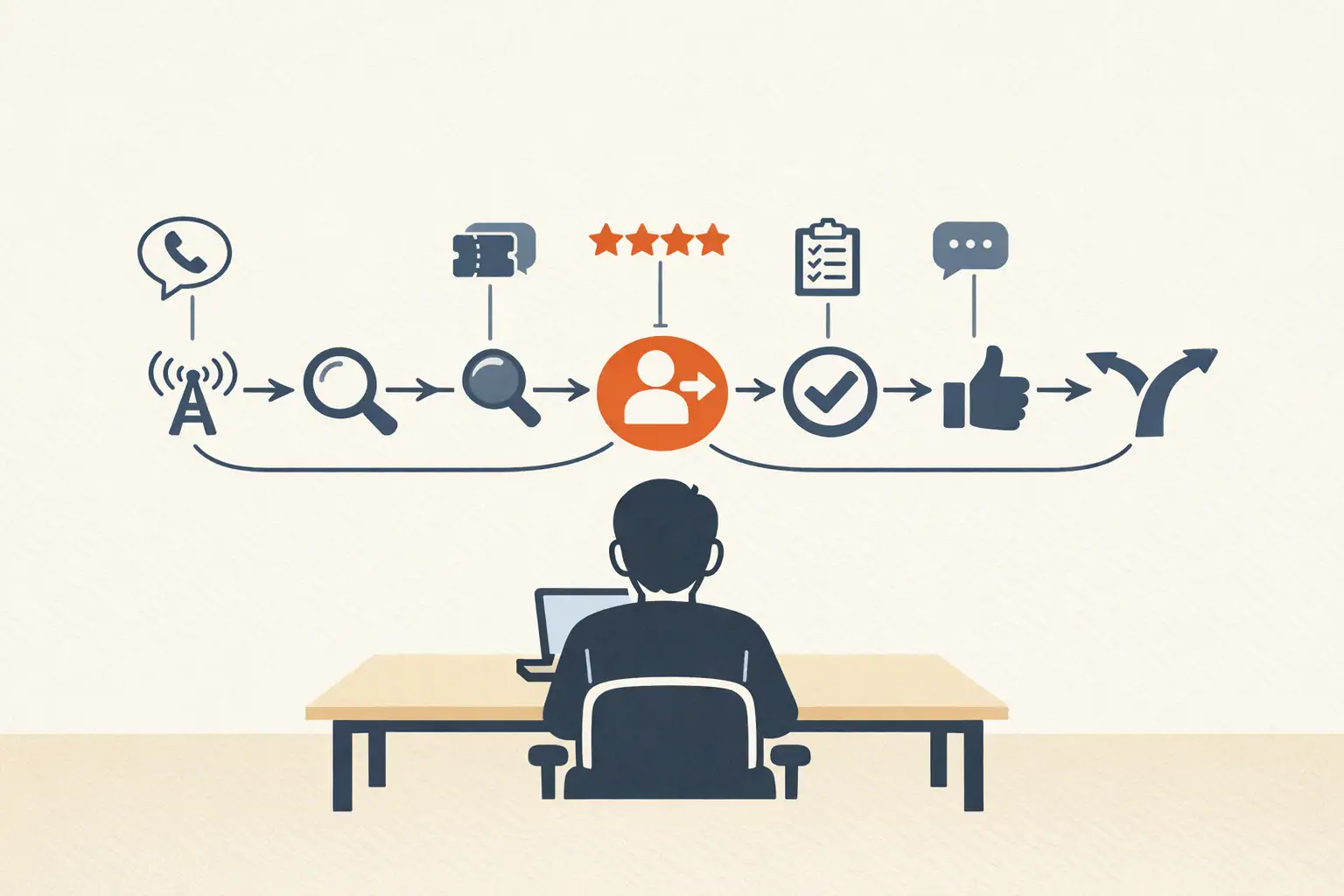
Sales call transcripts. Recorded discovery calls, win/loss interviews, demo Q&A. The richest source because the customer is speaking in their own voice and the questions reveal the actual decision criteria.
Support tickets. What people get stuck on, what they ask repeatedly, where they describe the product in their own language. The complaints and confusion are often more useful than the praise.
Reviews. External reviews on G2, Capterra, Yelp, Google, App Store. Public testimony you can pull without asking. Particularly useful for the “why I almost didn’t buy” patterns.
Surveys and exit interviews. Especially churn surveys. Customers who left know things customers who stayed haven’t articulated yet.
Sales-CRM notes. The free-text fields where reps capture what they heard. Messy, but operators usually write the truth.
Inbound form responses. What people typed when they reached out. Usually higher-signal than the demographic data fields.
Skip the data sources that don’t reflect customer language: web analytics (just behavior, not voice), firmographic data (just attributes), competitor research (about them, not your customers).
The persona generation workflow
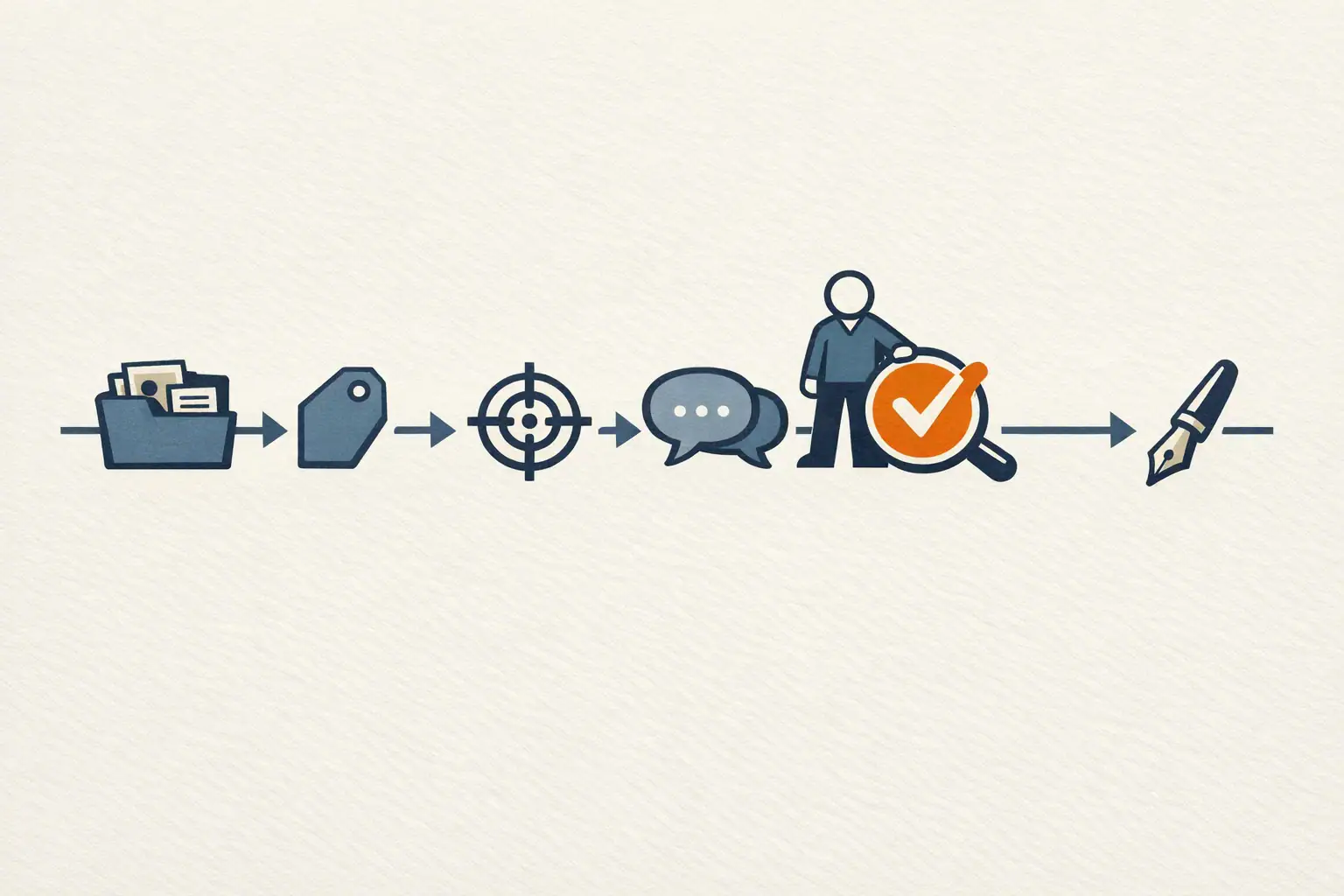
Six steps. The first three are about data prep. The middle two are the AI synthesis. The last one is the audit that keeps you honest.
Step 1: collect the raw inputs
Pull 6-12 months of data from each of the sources above. Export it to a single text dump, one row per piece of evidence (one transcript, one ticket, one review, etc.). Don’t pre-summarize. The AI does better work on raw text than on pre-digested summaries.
Target volume: 100-500 individual evidence pieces. Below 100 and the patterns are too thin. Above 500 and you’re pre-filtering more than you should.
Step 2: tag the evidence
Before running the AI synthesis, lightly tag each piece of evidence with:
- Source type (call, ticket, review, survey)
- Customer segment (industry, company size, role if known)
- Outcome (closed-won, closed-lost, active, churned)
- Date
The tagging matters because the AI’s pattern-matching needs to know what kind of evidence it’s reading. A churn-survey response and a win-call quote get weighted differently in synthesis.
Step 3: define what you’re trying to learn
Most personas fail because nobody decided what the persona was for. Before running synthesis, write down:
- Which decisions should this persona drive? (Landing page copy, ad targeting, pricing tier focus, etc.)
- Which segments should this persona cover? (One persona per ICP, or one master persona, or sales-led vs PLG split?)
- What’s the depth required? (Quick directional persona vs. deep multi-page persona doc?)
This is the step most teams skip. It’s also the step that separates useful personas from decorative ones.
Step 4: run the synthesis prompt
The prompt we use for AI persona generation:
You are helping a marketer at [company] build a customer persona from realevidence. Below is a corpus of [N] pieces of customer evidence, tagged bysource, segment, and outcome.For the segment "[target segment]", produce a persona that includes:- Role and seniority (in customer language, not job-title-formal)- The 3 phrases customers in this segment use most often to describe their problem- The 2 phrases they use to describe what they wish a solution would do- The 5 objections that show up most across closed-lost and churn evidence- The 3 trigger events that appear in win-evidence (what made them finally buy)- The 2 decision criteria that come up in both win and loss data- The 1 thing this segment cares about that no competitor is addressing- The 5 most quotable lines from the evidence corpus (verbatim)Cite the source evidence for each claim. Do not invent a person. Do notassign demographics. Do not produce a fictional name or stock photo.Evidence corpus:[paste tagged evidence]Format the output as labeled sections with verbatim quotes where possible.Note where the evidence is thin and you're inferring vs where you haveclear pattern support.
The key constraints in that prompt: – “Cite the source evidence for each claim” forces traceability – “Do not invent a person” stops the AI from generating fictional Sarah – “Note where the evidence is thin” stops the AI from over-claiming
Run this in Claude for the synthesis step. ChatGPT works for this too. We compared the two models for this kind of work in our Claude vs ChatGPT for marketing post. For the prompt-engineering rules that make synthesis prompts like this one work reliably, Anthropic’s prompt engineering documentation is the canonical reference.
Step 5: pressure-test the output
The first synthesis pass is the draft. Run a second prompt that audits it:
Below is a generated persona. For each claim, do the following:- Identify whether the supporting evidence is strong (3+ sources), moderate (2 sources), or thin (1 source or inferred)- Flag any claim that sounds generic enough to apply to any persona- Flag any claim that contradicts other claims in the persona- Flag any quote that appears to be paraphrased rather than verbatimPersona:[paste output from step 4]Original evidence:[paste tagged evidence]
This second pass catches the AI’s tendency to overstate confidence. The persona that comes out the other side is what actually goes into the team’s working doc.
Step 6: write the working version (human edit)
The AI synthesis produces evidence-grounded raw material. The human’s job is to turn it into the working persona doc:
- Cut claims marked “thin” or “generic” in the audit pass
- Tighten the language so the persona is scannable
- Add the “this persona drives these decisions” header so the doc has a purpose
- Save the underlying evidence so future audits can reference it
A working persona doc is usually 1-2 pages, not 12. The bloat in most persona docs is the inverse of how often they get read.
What an actual output looks like
Concrete example, since most posts on this topic are abstract.
For an early-stage B2B SaaS we worked with last quarter, the AI persona generator workflow on 312 pieces of evidence produced:
- Role: “Marketing of one” (their own phrasing from 8 win-call quotes), at companies between 20-80 employees
- Top problem phrases: “everything is on me,” “I’m running out of hours,” “I don’t have a marketing team, I AM the marketing team”
- Top wish phrases: “give me back Friday afternoons,” “stop being the bottleneck for everything”
- Top 3 objections: worried about voice consistency (12 sources), unsure they have time to onboard a new tool (9 sources), already burned by a previous AI tool that promised this (7 sources)
- Top trigger events: got asked to scale content output, lost a junior marketer, started reporting to a non-marketing CEO
- Unmet need: every competitor sells “do more”; this segment wants “do the same with fewer hours”
That’s a useful persona. It’s grounded in 312 pieces of evidence. Every claim can be traced. The “unmet need” line is what drove the landing-page hero rewrite that lifted conversion 14%.
For the broader content strategy that turns personas like this into ranked content, our SEO automation post covers how we feed persona language into keyword research.
Common mistakes that ruin AI-generated personas
Four patterns we keep watching:
Skipping the data step. Running the persona prompt with placeholder data or imagined inputs. Output is generic because input was generic.
Running the synthesis once. First draft is rarely good. The audit pass in step 5 is the difference between a usable persona and a fictional one.
Generating too many personas. Most teams need 1-3 personas. The instinct to produce 6-8 ends in a stack of unused docs. We covered the team-shape question of who actually uses personas in our 2-person AI marketing team post.
Treating personas as static. Customer base shifts. Personas should be regenerated every 6 months minimum, more often during big-market change. The synthesis is fast once the workflow is in place.
Why this matters more in 2026 than it did before
Two things changed:
First, AI made it tempting to generate fictional personas in 30 seconds and call them done. The bar for “we have personas” dropped without the bar for “useful personas” dropping with it. Teams now ship more bad personas, not fewer.
Second, AI made the synthesis of real evidence cheap enough to do well. The reason teams used to ship bad personas is the good version took weeks of qualitative coding. With Claude or ChatGPT handling the synthesis on tagged evidence, the good version takes hours.
The teams winning at persona-driven marketing in 2026 are the ones that take advantage of the second change without falling for the first.
For the safety side of letting AI touch customer data, our open-source AI agent safety post covers the permissions and review patterns that any AI workflow touching customer evidence should follow.
When to use a vendor persona generator vs. this workflow
The vendor-tool version of an AI persona generator (free or paid, HubSpot’s Make My Persona is the most-cited example) is fine for one thing: getting a directional persona for a brand-new business with no customers yet. Brainstorm-grade output is acceptable when you literally have no data.
The moment you have 20+ customers, switch to the evidence-grounded workflow above. The vendor tools don’t pull from your actual customer data, so their output stops being useful the moment you have real customers to learn from.
If your team wants help running this kind of evidence-grounded persona workflow on your stack, our services page explains how we work, and you can get in touch here.
FAQ
Can I run this workflow with no engineering help? Yes. The only technical step is pulling the data exports from your CRM, support tool, and review platforms. Everything else is prompting Claude or ChatGPT against the assembled corpus. Most teams can run the full workflow in an afternoon once the data is collected.
How many pieces of evidence do I really need? Floor is around 50-100 for a meaningful pattern, ceiling is around 500 before you start hitting context-window limits and need to chunk the input. The sweet spot for most B2B SaaS we work with is 200-300 pieces.
What if the AI invents quotes that look real but aren’t in the source data? This is exactly what the audit pass in step 5 catches. The prompt explicitly asks the AI to flag any quote that appears paraphrased rather than verbatim. Real evidence-grounded personas should have verbatim quotes that you can ctrl-F find in the source corpus. If you can’t find them, the AI hallucinated.
Should I use a separate persona for sales-led vs PLG? Usually yes. The evidence corpora are different (sales calls vs in-product behavior + support tickets), the buying-criteria language is different, and the trigger events are different. We’ve seen teams try to merge them and end up with a persona that doesn’t drive decisions for either motion.
How often should I regenerate personas? Every 6 months as the floor, every quarter during major market shifts (new ICP, new product, new competitor wave). The synthesis is cheap once the workflow exists; the cost is collecting the new evidence corpus.